Field notes
Steam, rain, and the slow shutter
New York hands you a smoke machine on every other corner and a mirror every time it rains. Both are free, both are unreliable, and both make the strongest frames of the year.
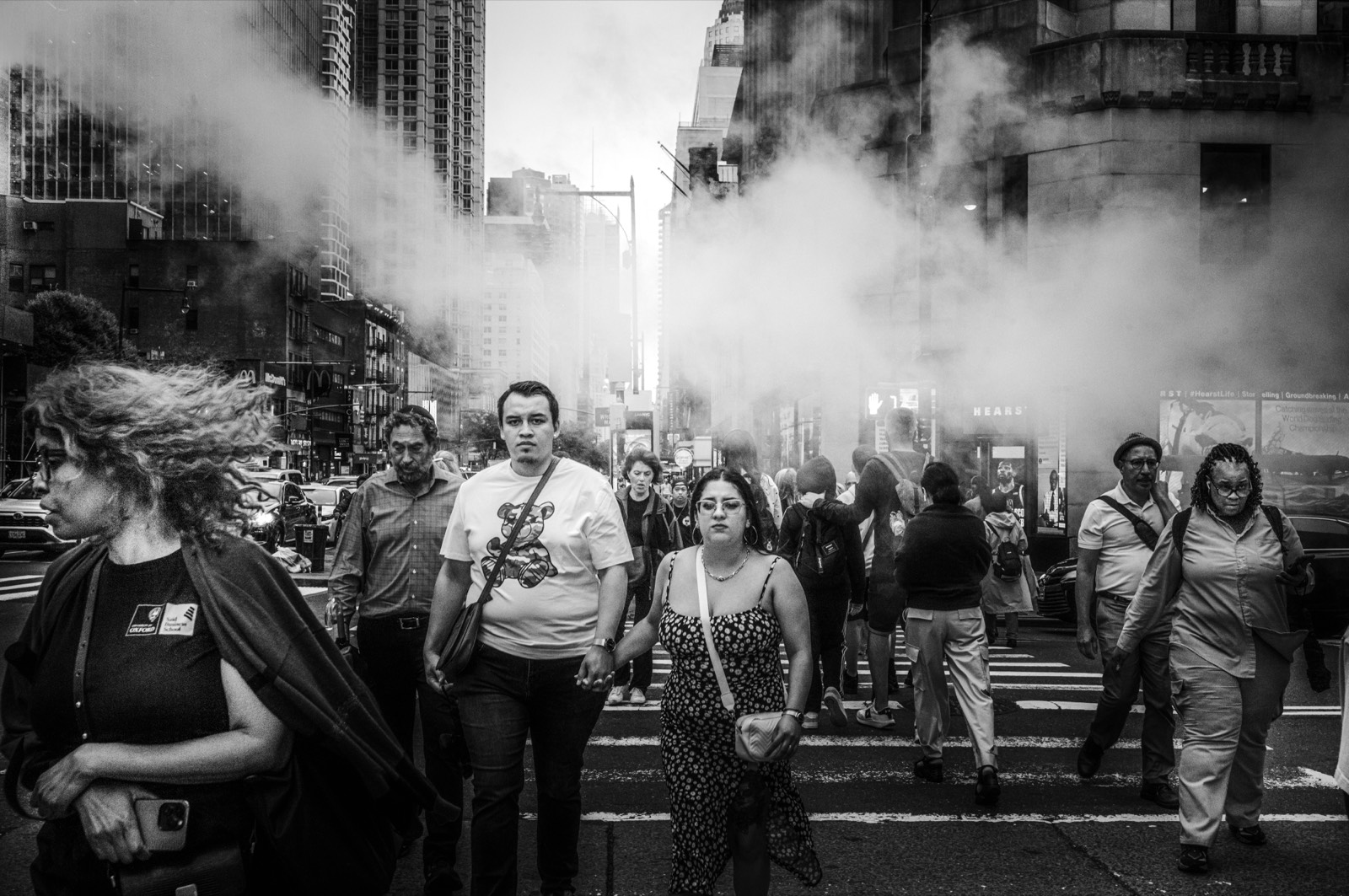
Underneath Manhattan runs a steam network that heats and cools a large part of the city, and where it meets the street it vents, sometimes from a grate, more often from those orange-and-white stacks that stand in the roadway like chimneys that got lost. On a cold morning the plume can be three storeys tall. On a warm one it barely clears the asphalt. Either way, it is the single most useful thing on the street: a moving, backlit, free-standing sheet of white that separates whatever stands in front of it.
Working a plume
Put the sun behind it. Steam only reads as steam when it is lit from behind or the side. Front-lit, it turns into flat grey mush that looks like a mistake. Walk the block until the plume sits between you and the light, usually that means shooting east early or west late, and it goes from atmosphere to spotlight.
Meter the plume, not the person. This is the whole technique in one line. The plume is the brightest thing in the frame and it is the one thing you cannot recover if you clip it. Expose so it holds texture, so you can still see it billowing rather than a white hole, and let everything in front of it go dark. You will be one to two stops "under" what the camera wants. That's correct.
Shoot the edges, not the middle. The picture is almost never inside the cloud. It's at the boundary where the plume thins and a figure is half-erased by it. Stand where that boundary crosses a path people take, a crosswalk, a subway stair, and wait.
Give it time. A plume breathes. It surges, collapses, drifts sideways with a passing truck. Two minutes at one vent will give you four completely different backgrounds. Most people take one frame and leave; the frame you want is usually the eleventh.
Practical warning
It is genuinely hot, and it is in live roadway. Stay on the kerb, keep the vent between you and nothing you care about, and don't back into traffic hunting an angle, the classic street-photography injury is a reversing van, not a burn.
Rain: the city becomes reflective
Rain doesn't dim a city, it doubles it. Wet asphalt turns into a broken mirror, and every light source above the street gets a twin below it. Three things follow from that.
Get low. Reflections obey the angle you view them from. Standing at eye level you see a wet road; crouching to waist height or lower, that same road turns into a full mirror of the signage above it. Half the difference between an ordinary rain frame and a good one is thirty centimetres of height.
Shoot into the light. Backlit rain is visible rain, individual drops, spray thrown off tyres, the halo around a headlight. Rain lit from behind you is invisible, and you end up with a photograph of a grey street that happens to be damp.
Expose for the reflection. Same discipline as steam. The bright spots in the puddles are your highlight, and they are what makes the picture read as rain. Protect them; let the buildings sink.
Two practical notes. An umbrella is a light-blocker, an obstruction, and a third hand you don't have, a cap and a jacket beat it. And a lens cloth in the pocket matters more than any accessory: on a wet night the front element picks up spray constantly, and one drop across the glass turns every highlight into a smear. Wipe between blocks, not between frames.
The slow shutter, used on purpose
Everything above assumes you're freezing the moment. The other option is to stop pretending motion is a problem.
At 1/15s, a walking figure keeps their shape but their feet and hands blur, enough to say "movement" without losing legibility. This is the safest slow speed and the one that works handheld on a wide lens if you brace properly.
At 1/4s to 1/2s, people become streaks. Now the subject has to be something static that the streaks move around: a person standing still in a crowd, a column, a lit doorway. The contrast between one sharp element and a field of blur is the entire picture, so the sharp element has to be worth it.
Panning, following a cyclist or a car at 1/30s or slower, keeps the subject sharp and smears the background into horizontal lines. It has a low hit rate. Expect one frame in fifteen, plan to shoot fifteen, and follow through after the shutter fires the way you would with a golf swing; stopping the movement at the click is what ruins most attempts.
In daylight this all runs into a wall: at 1/4s even at f/16 and base ISO you are massively overexposed. That's what a neutral density filter is for, a 3-stop is enough for overcast, a 6-stop for bright afternoons. Without one, slow-shutter work is a night and dusk technique only.
Bad weather is not a compromise you make. It is the only time the street looks like this, and everyone else has gone inside.
What to do with a wet night
Pick one intersection with a steam vent, a crosswalk, and a lit storefront behind it. Give it forty minutes. Shoot it frozen at 1/250s, then again at 1/15s, then get low and shoot the reflection. You will come home with one setup photographed four different ways, which is a far better result than four blocks photographed once each, and it's how you learn what a location can actually give you.