Photography
Seeing in monochrome
Three quarters of my archive has no colour in it. That isn't a filter applied at the end of the edit, it's a decision made before the shutter, and it changes what you point the camera at.
The fastest way to make a bad black-and-white photograph is to take a colour one and drain it. What's left is usually a picture that was held together by colour, a red awning against a blue wall, and once the colour goes, nothing holds it. The frame collapses into porridge: everything mid-grey, nothing separating from anything else.
Monochrome isn't the absence of colour. It's a different set of building materials. Once you commit to it, four things carry the picture, and colour is not among them.
What actually holds a mono frame together
Tonal separation. Every subject has to differ in brightness from what sits behind it, because brightness is the only channel you have left. A dark coat against a dark doorway is invisible in mono and perfectly legible in colour. Trained eyes learn to squint at a scene, literally, because squinting collapses colour and shows you the tonal map underneath.
Shape and edge. With colour gone, silhouette does the work of identification. A figure reads as a figure because of its outline, not its jacket. This is why backlight is such a gift in mono: it turns people into shapes and strips out the visual noise of what they happen to be wearing.
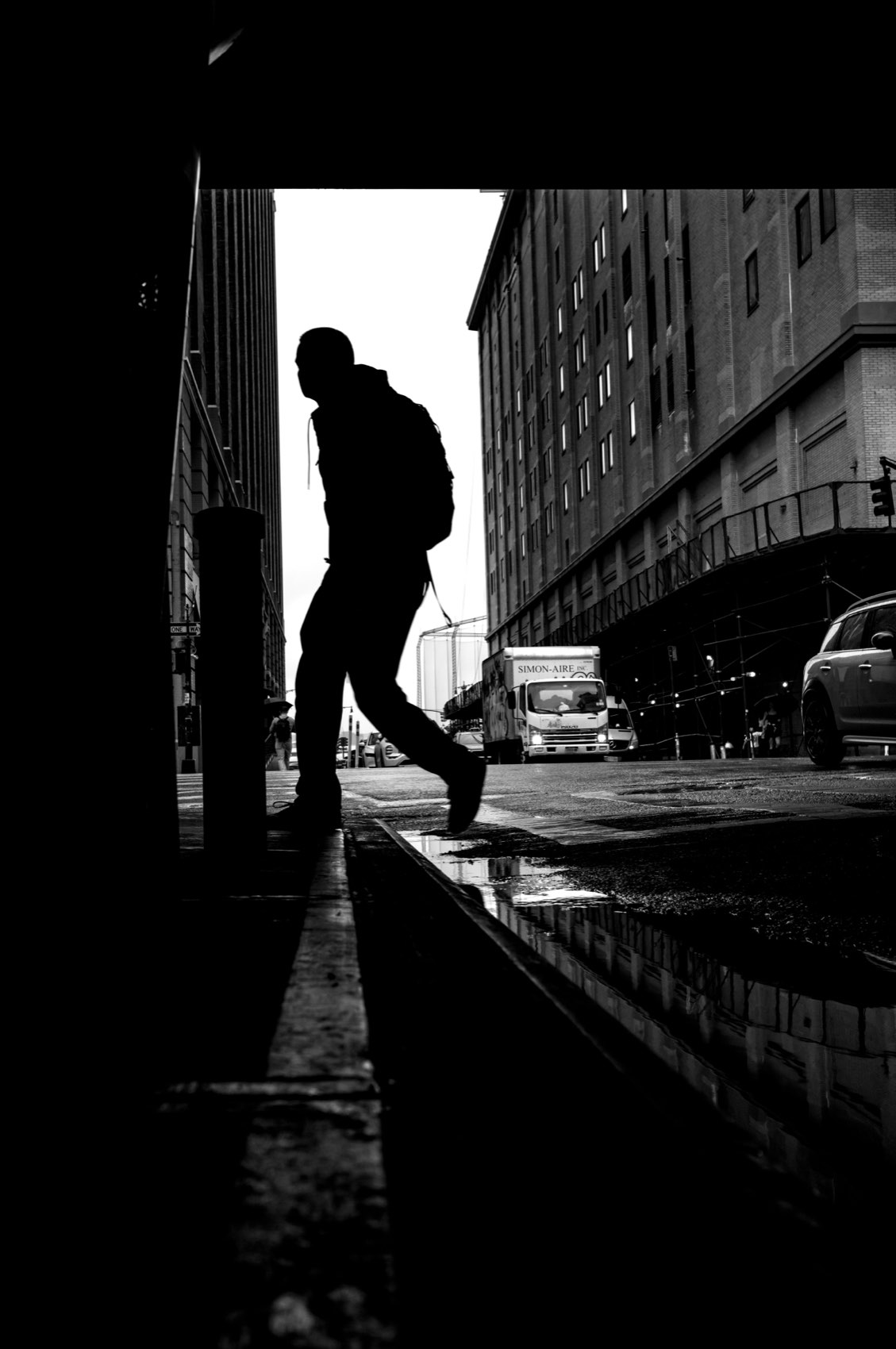
Light itself as subject. In colour, a shaft of light between two buildings competes with everything it lands on. In mono, it is simply the brightest thing in the frame, and the eye goes there first and stays. Half of street photography in black and white is finding where the light falls and waiting for something to walk into it.
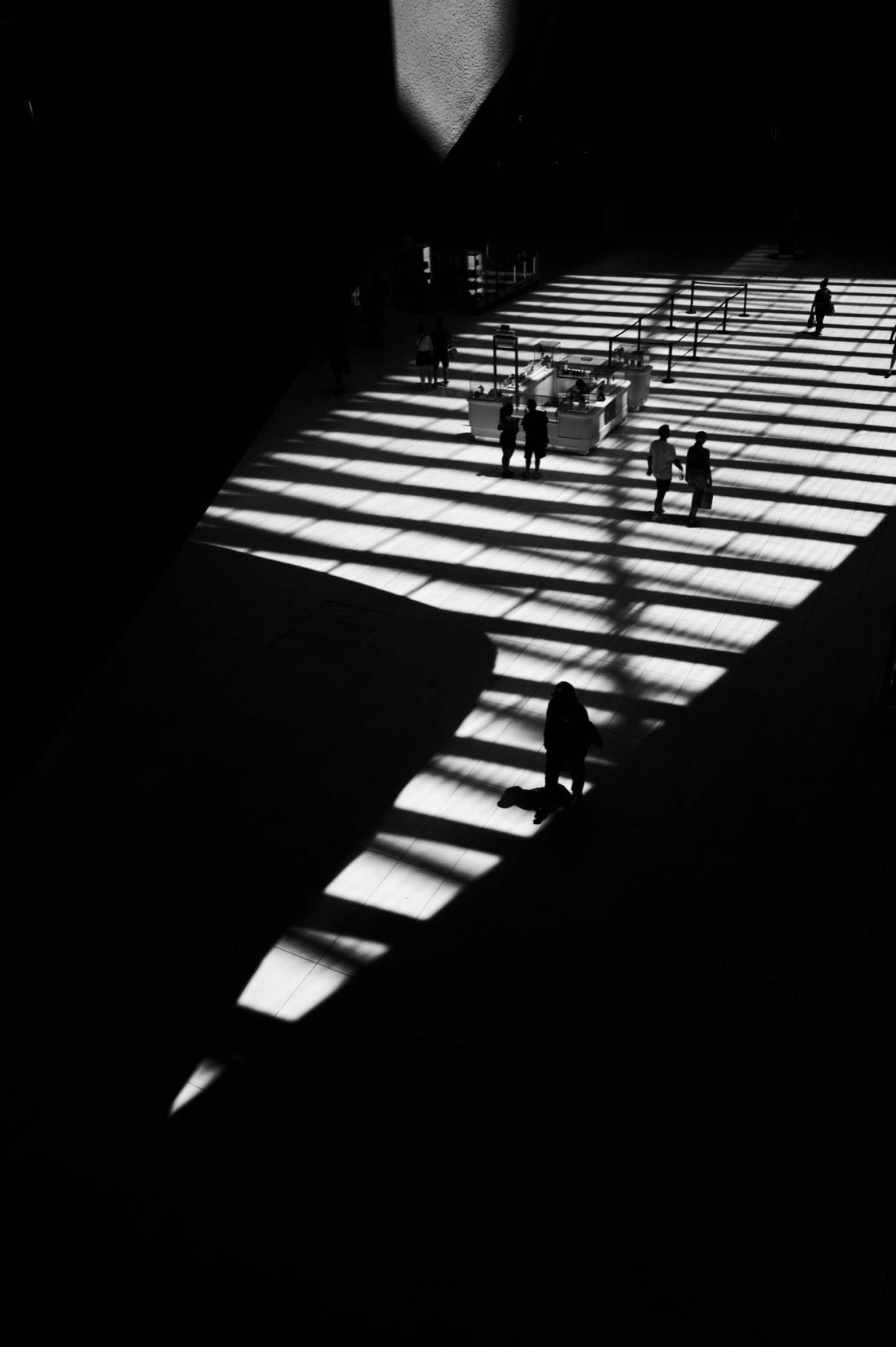
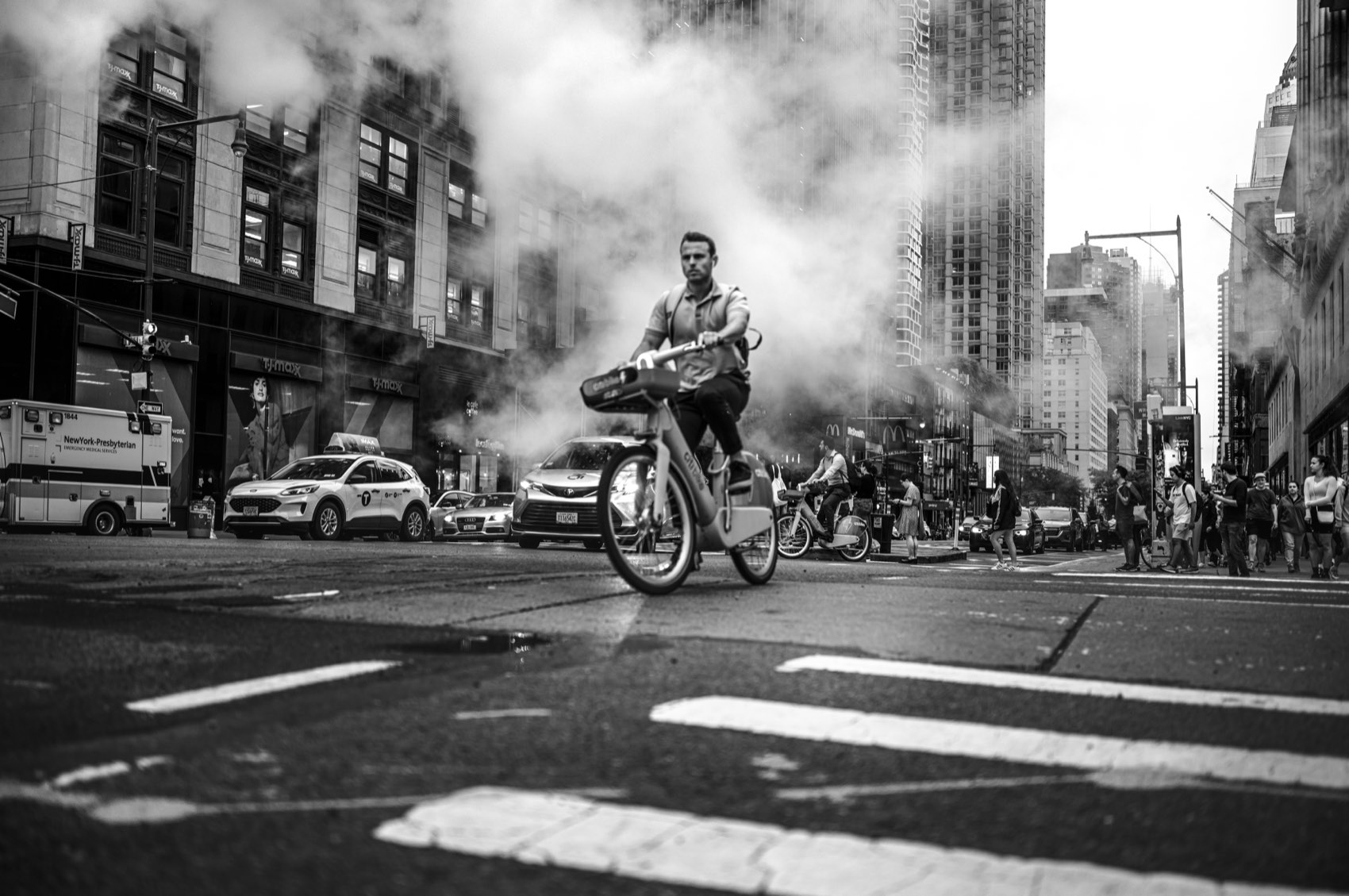
Texture. Wet asphalt, brick, steam, grain, fabric. Mono flatters texture because the tonal range that would otherwise be spent describing hue is spent describing surface instead.
If you can't describe a scene using only the words dark, light, and edge, it probably isn't a black-and-white photograph yet.
Previsualising: the squint, the map, the wait
Working on the street, this becomes a fast three-step loop that eventually runs without conscious thought.
- Squint at the block. Colour drops away and you see the tonal structure: where the deep shadows are, where the highlight pools sit, where the two meet in a hard edge.
- Pick the stage. Choose the patch of contrast that would make a subject legible, a lit crosswalk against a shaded building, a bright plume against dark glass. You are not looking for a subject yet. You are looking for a stage.
- Wait for the actor. Stand where the composition already works empty, and let the frame fill itself. This is the difference between hunting and fishing, and fishing wins over a whole day.
The discipline is in step two. Beginners find a subject and then try to solve the background. Mono punishes this, because a good subject on a tonally identical background disappears.
Exposure: protect the highlight, mine the shadow
Digital sensors record light linearly, which means roughly half of all the data they capture lives in the brightest stop of the image. Blow that stop out and it is gone, there is no colour information to reconstruct it from, and in mono there is no colour channel to borrow detail from either. Shadows, by contrast, are surprisingly recoverable on a modern sensor: lift them and you get noise, but noise in a black-and-white picture reads as grain, and grain reads as intent.
So the rule is asymmetric on purpose: expose for the highlights, and accept that the shadows will be dense. On a bright plume of steam with a figure in front of it, meter the plume, let the figure fall dark, and recover only as much of it as the picture needs. A silhouette with a little detail is stronger than a fully-described figure against a burnt-out white sky.
If you shoot with a dedicated monochrome sensor, one built without a colour filter array, this gets sharper in both senses. There is no demosaicing, so per-pixel acutance goes up noticeably, and the sensor is more sensitive because no light is being thrown away by filters. But there is also no colour data at all, which means no channel mixing later. You cannot decide in post that the sky should have gone darker. You make that decision with a physical filter on the lens, or you don't make it.
The one filter worth carrying
A yellow or orange filter darkens blue sky and lifts skin and brick, restoring some of the separation your eye expects. On a colour sensor you can do the same thing in the channel mixer afterwards. On a mono sensor, the glass is the only place it can happen, which is a good reminder that the decision belongs at the front of the process either way.
When colour is the right answer
Committing to mono doesn't mean pretending colour never wins. It wins whenever colour is the subject: a pastel building line at golden hour, a single saturated object in an otherwise neutral street, a scene whose entire point is the clash of two hues. Convert those and you have thrown the picture away.
The test I use is blunt. Ask: if I removed the colour, would there still be a photograph here? If yes, shoot it mono and let the structure carry it. If no, if the answer is "well, no, the whole thing is that the wall is pink", then it's a colour frame, and it belongs in a different set entirely. Mixing the two in one sequence is what makes a portfolio feel unresolved.
An exercise that works
Set the camera to a monochrome preview profile so the finder shows you grey, not colour. Shoot one block, a single block, four corners, for an hour, and don't move on until you have something. You will spend the first twenty minutes frustrated, the next twenty seeing tonal structure everywhere, and the last twenty making better pictures than you did all week. The constraint is doing the teaching, not the location.
Do that on ten blocks and previsualising stops being a technique. It becomes the way the street looks.